
My Clients Keep Asking Why Their $65 Foundation Looks Worse Than Drugstore Makeup By Noon (Here's What I Finally Started Telling Them)
By Marcus Chen, Celebrity Makeup Artist
4 min read

You know that sinking feeling when you check your makeup at 2 p.m. and realize it's settled into every line on your face?
Yeah. My clients used to know it too.
And for years, I watched it happen. I'd apply a $60 prestige foundation in perfect lighting, blend it flawlessly, and send them out the door looking radiant. Then they'd come back for their next appointment and quietly mention it "didn't quite work" at home.
At first, I thought it was a user error.
Then I started paying closer attention.
The foundations I'd been recommending for over a decade—all the names you know but I’m not allowed to say or they’ll sue me—were doing something strange on mature skin. They'd look perfect for about an hour. Maybe two.
Then they'd start oxidizing. Turning orange. Settling into smile lines. Making my clients look tired instead of polished.
And I couldn't figure out why.
These were luxury formulas. Award-winning products. Makeup artists around the world swore by them.
So what was I missing?
Turns out, I wasn't missing anything.
The formulas were.

The Day I Realized I'd Been Recommending The Wrong Foundations For Years
I'll never forget the moment it clicked.
I was working with a client in her late 50s. A gorgeous, confident, successful woman. She'd been coming to me for years.
She sat down in my chair and said something I'd heard a hundred times before:
"I don't understand why my foundation always looks great when YOU do it, but at home it just… sits there. Like a mask."
I started asking questions.
What was she using at home? The exact foundation I recommended.
How was she applying it? The exact technique I'd shown her.
Was her skin different lately? No, she had the same skincare routine.
Everything checked out.
But something wasn't adding up.
So I did what I should have done years earlier: I started researching the ACTUAL formulas I was using.
And that's when I realized something the beauty industry doesn't advertise:
Most foundations—even the expensive ones—are formulated for women in their 20s and 30s.
Not women over 50.
Let me explain what that actually means.
"This is the foundation I wish existed 20 years ago when I started working with mature clients," Linda Heidemann tells me. "It would've saved my clients thousands of dollars and countless mornings of frustration."


4.39/5 Stars from 3,605+ Verified Reviews
Mistake #1: Your Foundation Is Fighting Your Skin's Biology (And Losing)
When you hit your 40s and 50s, your skin changes. Dramatically.
Estrogen drops. Oil production slows down. Your skin gets drier, thinner, more sensitive to everything you put on it.
But here's the problem:
Most foundations are designed to do the exact opposite of what your skin needs.
They're built for oil control. Matte finishes. Long-wearing formulas that "lock in" and don't budge.
Which sounds great in theory.
Except your skin isn't oily anymore. It's dry. And when you layer a foundation designed to absorb oil on top of already-dry skin?
It sucks out what little moisture you have left.
The result? Foundation that looks cakey within hours. Settles into every fine line. And emphasizes texture instead of smoothing it.

I started testing this theory with my clients.
I asked them to bring in the foundations they were using at home.
Every single one had the same base: mattifying agents, oil absorbers, silicone primers designed to create a "flawless" finish on younger skin.
No wonder they weren't working.
Then I found something different.
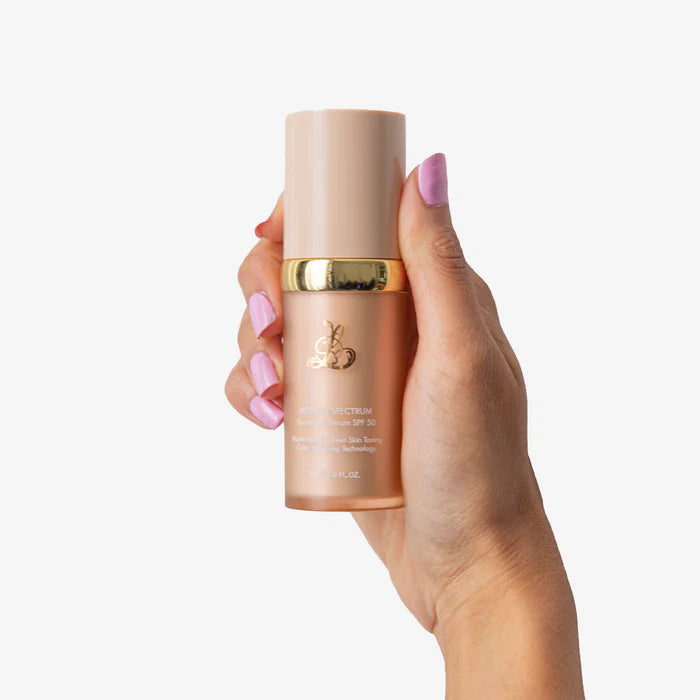
A friend of mine mentioned a small brand called Legacare. She'd been using their color-changing foundation and swore it was "the only thing that doesn't settle into her lines."
A color-changing foundation? I was skeptical.
I'd seen those cheap gimmicks on Amazon. The ones that promise to "adapt to any skin tone" but end up looking like a weird peachy mess.
But she kept raving about it. So I tried it on myself first.
And I'm not gonna lie—it was strange.

The formula comes out white. Completely white.
Then, as you blend it, it starts shifting. Warming up. Adjusting.
Within 30 seconds, it matched my exact skin tone. No guessing. No mixing shades.
But here's what really got me:
The formula was hydrating.
Not greasy or heavy. Just genuinely moisturizing.
It had Hyaluronic Acid (which holds 1,000 times its weight in water), Vitamin E, and Collagen built into the base. The texture was creamy and lightweight. It didn't grip onto dry patches or sit on top of my skin like a mask.
It melted in.

I immediately tested it on three of my mature clients. Each had different skin tones, textures, and varying levels of dryness.
All three had the same reaction:
"This is the first foundation that doesn't make my wrinkles look worse."
That's when I stopped recommending traditional foundations altogether.
Mistake #2: The Beauty Industry Expects You To Be A Shade-Matching Expert (You're Not. And That's Not Your Fault.)
Let me ask you something.
How many half-used foundation bottles are sitting in your bathroom drawer right now?
Three? Five? Ten?

Most of them are probably the "wrong" shade. Too pink, yellow, dark, or light. Even though it looked perfect in the store, it turned orange by lunchtime.
I see this with every new client who sits in my chair.
They apologize for not knowing their shade. They tell me they've tried "everything" and nothing matches.
And I always say the same thing:
It's not your fault.
The beauty industry has set you up to fail.
Think about it.
You're supposed to walk into a store with fluorescent lighting, test a foundation on your hand (which is a completely different tone than your face, by the way), and somehow predict how it's going to look in natural light.
On your actual skin. After it's been sitting on your face for six hours.
Oh, and your skin tone changes with the seasons. And with hormonal shifts. AND with sun exposure.
But sure, pick one shade from a wall of 40 options and hope for the best!
Let’s get real, girl: It's absurd.
And expensive.
One of my clients told me she'd spent over $200 in the past year alone just trying to find a foundation that matched. She'd buy one, try it at home, realize it didn't work, and either return it or let it collect dust.
When I introduced her to Legacare's color-changing formula, she looked at me like I was joking.
"There's no way one shade works for everyone."
I get it. It sounds too good to be true.
But here's the thing: it's not one shade that "works for everyone." It's a formula that adapts to YOU.

The technology is called pH-reactive pigments. As you blend the foundation into your skin, it reads your skin's natural pH level and adjusts the color to match your exact tone.
✅ Winter pale? It adjusts.
✅ Summer tan? It adjusts.
✅ Hormonal changes shifting your undertone? It adjusts.
No more guessing. No more returns. No more drawer full of "almost right" bottles that oxidize by 2 p.m.
One of my clients texted me a week after switching:
"I've been using the same bottle for three months and it still matches perfectly. Even after I got back from vacation with a tan. How is that possible?"
That's how.
Mistake #3: Your Foundation Thinks You're Trying To Look Like A Filtered Instagram Photo (You're Not)
Here's something nobody in the beauty industry wants to admit:
Most foundations are designed for social media. Not real life.
Full coverage. Flawless finish. Airbrushed perfection. Built to look good in a selfie with a ring light and three filters.
But when you're standing in natural light? Or sitting across from someone at lunch?
It looks like a mask.

Most of them are probably the "wrong" shade. Too pink, yellow, dark, or light. Even though it looked perfect in the store, it turned orange by lunchtime.
I see this with every new client who sits in my chair.
They apologize for not knowing their shade. They tell me they've tried "everything" and nothing matches.
And I always say the same thing:
It's not your fault.
The beauty industry has set you up to fail.
Think about it.
You're supposed to walk into a store with fluorescent lighting, test a foundation on your hand (which is a completely different tone than your face, by the way), and somehow predict how it's going to look in natural light.
On your actual skin. After it's been sitting on your face for six hours.
Oh, and your skin tone changes with the seasons. And with hormonal shifts. AND with sun exposure.
But sure, pick one shade from a wall of 40 options and hope for the best!
Let’s get real, girl: It's absurd.
And expensive.
One of my clients told me she'd spent over $200 in the past year alone just trying to find a foundation that matched. She'd buy one, try it at home, realize it didn't work, and either return it or let it collect dust.
When I introduced her to Legacare's color-changing formula, she looked at me like I was joking.
"There's no way one shade works for everyone."
I get it. It sounds too good to be true.
But here's the thing: it's not one shade that "works for everyone." It's a formula that adapts to YOU.
Because here's the reality: your skin has texture. Fine lines. Pores. A little bit of crepiness, especially around the eyes and jawline.
And when you layer a thick, heavy foundation over that texture?
It doesn't hide it. It highlights it.
The foundation settles into your smile lines. Cakes up in your pores. Sits on top of your skin like a layer of spackle.
You don't look polished. You look like you're wearing too much makeup.
One of my clients said it perfectly:
"I just want to look like myself. But better. Not like I'm wearing a costume."
And that's exactly what the 4-in-1 Color Changing Foundation does.
The formula is lightweight. Buildable. Breathable.
You can layer it where you need more coverage—redness, age spots, uneven tone—without it ever looking heavy or cakey.
And here's the part that shocked me:
It actually glides over fine lines instead of settling into them.

I tested this on a client in her 60s with deep smile lines. The kind of lines that every other foundation I'd tried would sink right into.
I applied the 4-in-1 Color Changing Foundation. Blended it out.
And it just… moved with her skin. No creasing. No caking. No emphasizing.
She looked at herself in the mirror and teared up a little.
"I look like me again."
That's when I knew I'd never go back to recommending traditional formulas.
Mistake #4: You're Spending 20 Minutes Layering Products Your Skin Doesn't Even Want
Okay, real talk.
How long does it take you to "put your face on" in the morning?
If you're like most of my clients, it's at least 15 to 20 minutes. Sometimes longer.

❌ Primer to smooth texture.
❌ Color corrector to neutralize redness.
❌ Concealer to cover dark circles and age spots.
❌ Foundation to even out tone.
❌ Powder to set everything so it doesn't slide off by noon.
That's five products. Minimum.
And you know what happens when you layer that many products on mature skin?
They don't play nice together.
They separate. They get patchy. One product lifts the other. Your skin feels heavy and suffocated.
And after all that effort? It still doesn't look as good as you wanted it to.
Here's the truth the beauty industry doesn't want you to know:
They make more money when you buy five products instead of one.
That's it. That's the business model.
But your skin doesn't need four products. It needs one product that actually works.

That’s where the 4-in-1 Color Changing Foundation comes in.
Primer. Concealer. Foundation. Color-correcting. All in one bottle.
You apply it. You blend it. You're done.
One of my clients in her late 50s told me:
"I used to spend half an hour on my makeup every morning. Now I'm out the door in five minutes and I actually look better than I did before."
That's not an exaggeration.
When you use a formula that's designed to work with your skin instead of against it, you don't need all the extra steps.
You just need the right foundation.
But Then Something Weird Happened...
After I started recommending Legacare to my mature clients, I noticed something I wasn't expecting.
They stopped asking me for product recommendations….
Not because they didn't trust me anymore. But because they'd finally found something that worked. And they didn't need to keep searching.

One client told me she'd cancelled her standing appointment at Sephora.
Another said she'd stopped watching YouTube tutorials on "how to make foundation work on mature skin."
They weren't struggling anymore.
They weren't wasting money on products that didn't deliver.
They weren't spending their mornings stressing about whether their makeup would last through lunch.
They were just… happy.
And honestly? That's when I realized how broken the system had been all along.
The beauty industry had convinced them—convinced all of us—that makeup was supposed to be complicated.
That you needed a degree in color theory to find your shade. That looking polished required an arsenal of products and 30 minutes every morning.
But it doesn't.
You just need a formula that was actually made for you.
I WANT SOMETHING THAT FINALLY WORKS
What My Clients Are Saying (And Why I'm Sharing This With You)
I don't get paid to talk about Legacare.
I'm sharing this because I watched my clients struggle for years with foundations that weren't designed for their skin. And when I finally found something that worked, it felt wrong to keep it to myself.
Here's what real women are experiencing:

These aren't celebrities. They're not getting paid to say this.
They're just women who finally found a foundation that works with their skin instead of against it.
Here's The Part Where I Tell You It's Not Perfect (Because Nothing Is)
Look, I'm not going to sit here and tell you Legacare is going to erase your wrinkles or make you look 20 years younger.
It won't.
It's foundation, not magic.
But what it will do is give you buildable, breathable coverage that doesn't settle into your lines, matches your exact skin tone without guessing, and actually hydrates your skin instead of drying it out.
It'll save you time in the morning. Save you money on products that don't work. And give you that "I look like myself, just better" confidence you've been chasing.
Is it going to work for every single person? Probably not.
The color-adapting technology works best on light to medium-deep skin tones. If you're very deep or very fair, it might not adjust perfectly.
But for most women? It's the first foundation that finally makes sense.
YES, I WANT THIS
Why Right Now Is The Best Time To Try It (And Why Waiting Might Cost You)
Here's the deal.
Legacare is a small brand. They don't have unlimited inventory sitting in warehouses around the world.
Which means stock tend to move moving fast.
I've had clients tell me they went to order and saw an "out of stock" message. A few days later it was back. Then it sold out again.
If you're reading this and thinking, "I'll try it next month," I get it.
But there's a decent chance it won't be available next week. Or the promotion will be over and you'll pay full price.
And honestly? After years of watching women waste money on foundations that don't work, I'd hate for you to miss out on the one that actually does.
Tap the button below to see if Legacare's Original Changing Foundation is still available—and finally experience what a foundation made for mature skin actually feels like.
Check Availability
Comments (8)

Sharon M.
Oh my gosh, I literally have 7 bottles of foundation in my drawer right now that don't match. This is SO accurate it hurts lol. Just ordered the BOGO deal, fingers crossed this actually works!
24 Likes
Reply
2 days ago

Jennifer T.
I've been using Legacare for about 6 weeks now and honestly? Marcus is right. It's the first foundation that doesn't make my laugh lines look deeper by lunchtime. I'm 62 and I actually feel confident going makeup-free on weekends now because my skin looks better overall. Wish I'd found this years ago.
47 Likes
Reply
1 days ago

Debra K.
Anyone else skeptical about the "color-changing" thing? I tried one of those cheap ones from Amazon last year and it was a disaster. But I'm willing to give this a shot with the money-back guarantee. Has anyone with really dry skin tried it?
12 Likes
Reply
3 days ago

Jennifer T.
YES! My skin is super dry (menopause is fun 🙄) and this actually hydrates instead of making it worse. I don't even need primer anymore.
31 Likes
Reply
1 days ago

Linda R.
I spent $68 on Charlotte Tilbury foundation last month and it turned orange on me within 2 hours. SIXTY-EIGHT DOLLARS. I'm so tired of wasting money on products that don't work for mature skin. Ordering this tonight.
56 Likes
Reply
5 days ago

Kathy P.
Question - does this work on deeper skin tones? The article says "light to medium-deep" but I'm a deeper medium and don't want to waste my money if it won't adapt properly.
9 Likes
Reply
4 days ago

Marcus Chen
Great question! It works best on light to medium-deep tones. If you're deeper than a MAC NC45, it might not adjust perfectly. I always recommend trying it with the guarantee in mind - if it doesn't match, you can return it. But I've had clients around NC40-42 who love it!
18 Likes
Reply
3 days ago

Patricia W.
I'm 71 and just got mine yesterday. Applied it this morning and I'm genuinely shocked. It's 3pm and I still look... normal? Not cakey? Not orange? I don't understand the science but I don't care, this WORKS. Thank you for writing this article!
89 Likes
Reply
1 days ago

Susan L.
The part about the beauty industry making more money when we buy 5 products instead of 1... oof. That hit different. I've been buying primer, concealer, foundation, and setting powder separately for YEARS. What a racket.
43 Likes
Reply
6 days ago

Mary B.
Just want to say THANK YOU for being honest about what it won't do. So many products promise to "erase wrinkles" and "turn back time" and it's such BS. I just want something that doesn't make me look worse, and it sounds like this might actually be it. Ordered!
67 Likes
Reply
2 days ago